yUdjEha aKAyôya
Yuchi Opening Song
Translated by Halay Turning Heart
Written by the Yuchi Language Project
“This song was written for the children at the Yuchi Language Project and is led by the children every morning first thing as a declaration and reminder of our purpose as we face the Sun and start the day with affirmation and intention. Many of the song lyrics are phrases our Elders used.“ - Halay Turning Heart, Project Administrator at the Yuchi Language Project.

YUCHI:
yUdjEha aKAyôya... yUdjEhalA'wAdA
yUdjEha zA'yada... s@nlA dOt@sh'a
yUdjEha KAdû... zOyaha KAdû
Ôzo yUdjEha gO'WAdAnA-A n@wadonô
yUdjEha Ânô sô KAÂnô
yUdjEhalA TahAÔK'âfA
gOh@nTOnA wAs@nlA
yUdjEha @yOôdaya... yUdjEhalA' WAdA
yUdjEhalA hOTa... yUdjEhalA hE'kû
gOh@nTOnA nedzAnÔtE
nÔzEOshEIA nÔzAtyûnô
nÔzA ky@hanô
n@ ÔwûlAnô agat'AjElA
TahAê Ôk'âfÂ
gOh@nTOnA WAs@nlA
ENGLISH:
If you are Yuchi speak Yuchi.
I really like that I am Yuchi.
I am Yuchi and a child of the Sun.
Our Yuchi language will not die.
We the Yuchi people are still here.
We are carrying on the Yuchi way of life.
God is good.
If you all know Yuchi speak Yuchi.
Teach the Yuchi way and
use the Yuchi language.
God we ask of you to
bless us, help us, watch over us.
We will not give up, every single day
we will carry it forward.
God is good.
Mvskoke (Creek) Lullaby
1943
This Mvskoke Creek lullaby was recorded in the summer of 1943 at the Haskell Institute in Lawrence, Kansas. The vocalist, a student, is known only as Margaret. The song was recorded by Willard Rhodes, Professor of music at Columbia University. He was employed by The Bureau of Indian Affairs to compile a recorded catalogue of Native American Songs.Note that the word 'Pipe' is a Mvskoke spelling for the English word 'Baby'. Generally, 'baby' would be 'estuce' in Mvskoke.
Mvskoke: English:
Pipe, nocv Baby, sleep
nocv nocv sleep sleep
Locv hopokvn ayvnks ce He went looking for turtle shells.
Pvkseno rvlvkahes tomorrow he will return,
Makketo ayvnks ce he said when he went.
Pipe, nocv Baby, sleep
nocv nocv sleep sleep
Locv hopokvn ayvnks ce He went looking for turtle shells.
Pvkseno rvlvkahes tomorrow he will return,
Makketo ayvnks ce he said when he went.
Pipe, nocv Baby, sleep
Momis Komet, Vpeyakvres
(Keep striving, we will go)
Mvskoke Hymn
This hymn, Momis Komet Vpeyakvres, means “Keep striving, we will go.” It belongs to a deeply rooted musical tradition known as the American Indian church hymn; a distinct result of cultural blending during early European contact.
As missionaries traveled across Indian Country, they translated scripture and hymns into Native languages, leading to a new form of hybrid music composed and sung by tribal citizens. Among Southeastern tribes such as the Mvskoke (Creek), Choctaw, Chickasaw, Cherokee, and Seminole, this style has flourished for over two centuries. Its sound is unmistakably Native, forming a third pillar of traditional music alongside stomp dance songs and ancient folk melodies.
Momis Komet, vpeyakvres,
Keep striving, we will go,
Herkvt cem ocvkes,
You will have peace (there),
Momis Komet, vpeyakvres,
Keep striving, we will go,
Herkvt cem ocvkes,
You will have peace (there),
Mekusapvlke vpeyvnna,
The Christians that have gone on,
Herkvt cem ocvkes,
You will have peace (there),
Mekusapvlke vpeyvnna,
The Christians that have gone on,
Herkvt cem ocvkes,
You will have peace (there),
Pvmvpvltake vpeyvnna,
Our others that have gone on,
Herkvt cem ocvkes,
You will have peace (there),
Pvmvpvltake vpeyvnna,
Our others that have gone on,
Herkvt cem ocvkes,
You will have peace (there),
Momis Komet, vpeyakvres,
Keep striving, we will go,
Herkvt cem ocvkes,
You will have peace (there),
Momis Komet, vpeyakvres,
Keep striving, we will go,
Herkvt cem ocvkes,
You will have peace (there),
Momis Komet, vpeyakvres,
Keep striving, we will go,
Herkvt cem ocvkes,
You will have peace (there),
Mekusapvlke vpeyvnna,
The Christians that have gone on,
Herkvt cem ocvkes,
You will have peace (there),
Momis Komet, vpeyakvres,
Keep striving, we will go,
Herkvt cem ocvkes,
You will have peace (there),
Momis Komet, vpeyakvres,
Keep striving, we will go,
Herkvt cem ocvkes,
You will have peace (there),
Vkvsamvlke vpeyvnna,
Believers that have gone on,
Herkvt cem ocvkes,
You will have peace (there),
Vkvsamvlke vpeyvnna,
Believers that have gone on,
Herkvt cem ocvkes,
You will have peace (there),
Momis Komet, vpeyakvres,
Keep striving, we will go,
Herkvt cem ocvkes,
You will have peace (there),
Momis Komet, vpeyakvres,
Keep striving, we will go,
Herkvt cem ocvkes,
You will have peace (there),
Erkenakvlke vpeyvnna,
The ministers that have gone on,
Herkvt cem ocvkes,
You will have peace (there),
Erkenakvlke vpeyvnna,
The ministers that have gone on,
Herkvt cem ocvkes,
You will have peace (there),
Momis Komet, vpeyakvres,
Keep striving, we will go,
Herkvt cem ocvkes,
You will have peace (there),
Momis Komet, vpeyakvres,
Keep striving, we will go,
Herkvt cem ocvkes,
You will have peace (there),
Puwantake vpeyvnna,
Our sisters that have gone on,
Herkvt cem ocvkes,
You will have peace (there),
Puwantake vpeyvnna,
Our sisters that have gone on,
Herkvt cem ocvkes,
You will have peace (there),
Momis Komet, vpeyakvres,
Keep striving, we will go,
Herkvt cem ocvkes,
You will have peace (there),
Momis Komet, vpeyakvres,
Keep striving, we will go,
Herkvt cem ocvkes,
You will have peace (there),
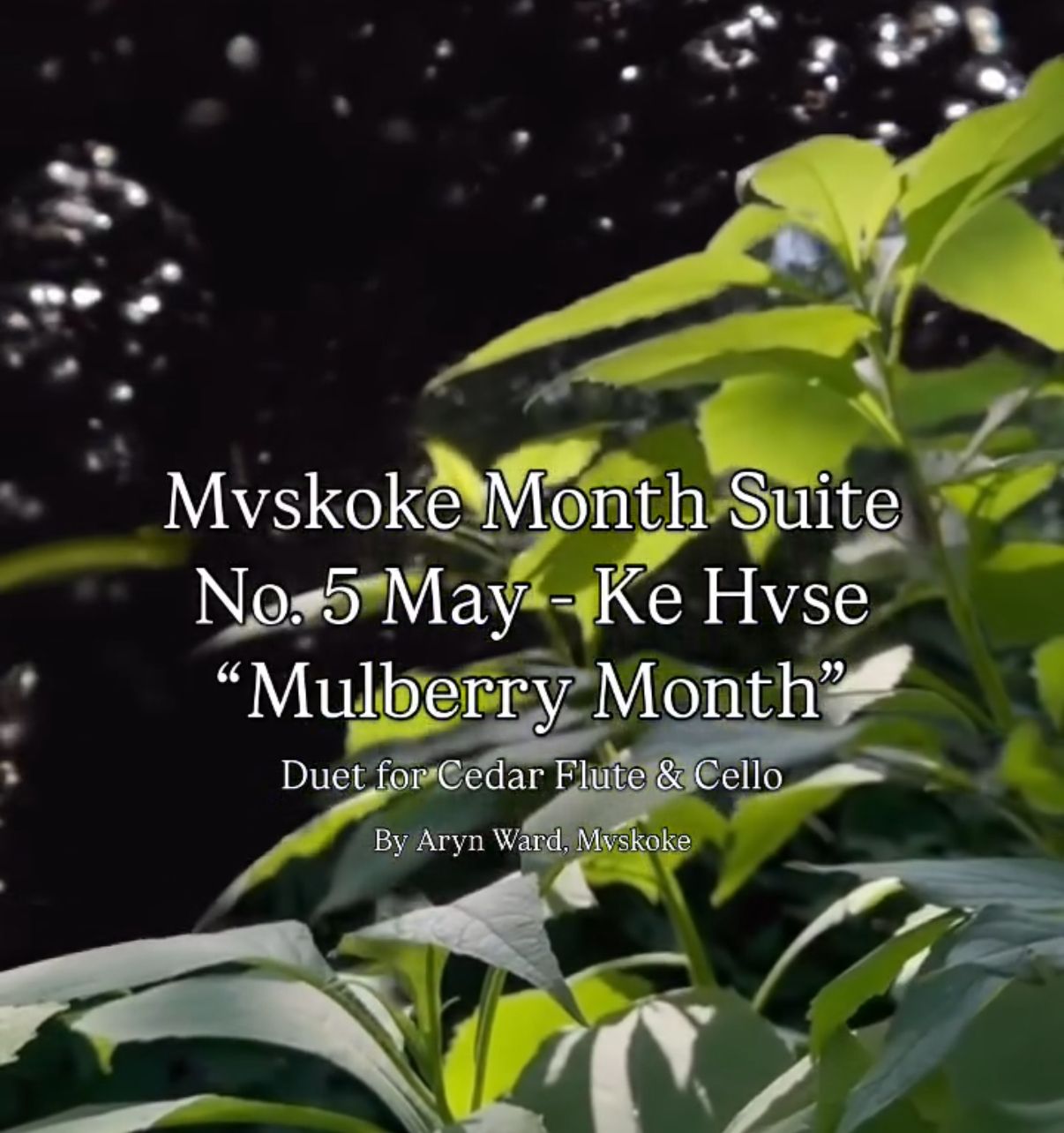
Mvskoke Months Suite No. 5
May - Ke Hvse “Mulberry Month”
by Aryn Ward, Mvskoke (Yuchi)
Ke Hvse pronounced “Gee Huss-E”, is a duet for cedar flute and cello that captures the warmth, rhythm, and memory of May in Mvskoke country; Ke Hvse, the “Mulberry Month”. this piece was written from flashes of memories of picking mulberries by the brook near Aryn’s parent’s house in Sapulpa, OK.
The pizzicato and staccato cello lines mimic the gentle plucking of ripe berries from branches, while sustained tones evoke the heavy warmth of the sun overhead. Occasional descending motifs hint at raindrops that might fall between moments of calm. Inspired by my childhood days gathering mulberries near a creek down the road from my house, this piece invites listeners into a sensory and nostalgic soundscape where tradition, memory, and nature meet in music.
Choctaw Hymn 112
Tahlepa Achufa Akohcha Auahtuklo
Vba Isht Taloa 112
arranged by Charles Shadle (b. 1960)
Choctaw: English:
Nitak kanima fehna ho Someday I will die.
Si ai illi hokma, I can only lean on him.
Aki vba binili mvt My father who sits above
Is sa halanlashke. Hold on to me.
Chisvs pulla tuk mak ona, It is because of Jesus that
Si ai illi hokmvt. I can only lean on him.
Coyotes
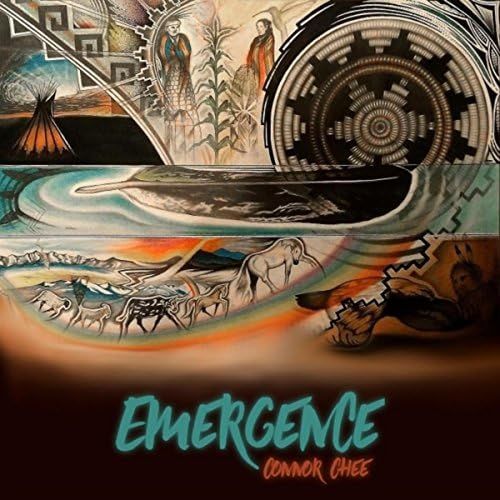
by Connor Chee, Diné
Coyotes is inspired by Diné creation stories, from the First World when two coyotes came into being: Great Coyote, born of the water, and First Angry, who claimed to exist before the people. I wanted to capture that mysterious threshold of becoming, when these creatures first stirred the stillness and shaped the balance between curiosity and chaos. Their voices weave through the music—the cautious wonder of Great Coyote and the restless energy of First Angry—each reflecting the tension between creation and disruption. The theme introduced here later returns in The Water Monster, connecting the collection of pieces through sound and story.
Eroica
by Anjelica Lindsey, Cherokee
Composed under the mentorship of Dr. Daniel Felsenfeld during her Juilliard studies, Cherokee composer Anjelica Lindsey’s EROICA for Wind Trio marks a pivotal point in her artistic development, immediately preceding her monumental work, REQUIEM.
The piece serves as a textural exploration of beauty through the interwoven timbres of flute, clarinet, and bassoon. It presents a variation on Lindsey’s recurring Soliloquy theme, venturing into new harmonic and thematic territories while incorporating elements of deconstructed jazz. The work culminates in an uplifted conclusion that symbolizes a distinctly feminine form of heroism, an introspective, yet quietly triumphant expression of the “Eroica,” a term that, while masculine in its traditional associations with “hero,” here takes on a feminine inflection through the Italian suffix “-a.”
Composed during a period of personal and artistic transformation, EROICA reflects Lindsey’s evolving fluency in classical notation and her growing confidence as a composer. The experience of having this piece read at Juilliard became a vital precursor to her later REQUIEM, the first work of its kind written in the Cherokee language, a landmark synthesis of cultural identity and compositional ambition.
*This piece will be played with cello instead of bassoon for this performance.
Reclaim the Land
by Kirsten C. Kunkle
Written for the 150th anniversary of Yellowstone National Park
Commissioned by Mountain Time Arts
Reclaim the Land was submitted to the Dismantling Coalition’s Sacred Lands Playlist. It was accepted as part of our second volume of songs which will be released in 2026.
From the artist:
This song was commissioned by Mountain Time Arts for the 150th anniversary of Yellowstone National Park, specifically to be premiered by me at the All Nations Teepee Village.
The piece centers around Yellowstone specifically, but on a greater level, all lands, and the importance of preserving them and co-existing with the existing flora and fauna.
Being a Mvskoke (Muscogee) citizen, this work is meant to be a new anthem for Yellowstone and a tribute to all Indigenous peoples who support the nurturing of land in its most natural state.
Now is the time,
Reclaim the land.
Share it, bridge the divide.
Reclaim the land,
And find a new day.
A new day.
Water has value.
Our people cannot be removed.
Hair stays long, and braids are never cut.
Schools do not exist to change us.
Women are no longer missing,
Our bodies never found.
Now is the time!
Now is the time!
The great arch stands.
Illuminated tipis demand attention amid the big sky.
We demand attention.
Now is the time.
The land is ours,
Sharing it with elk, bison, geysers, and trees…
The red sunset, snowy mountains, flowing water.
The collective breath that is nature.
Now is the time.
Remember who we are, and who we always have been.
Reclaim the land.
Become part of the landscape again!
Kanohelvsgi Tsunilosvhi
by Kiegan Ryan
Ryan composed the song cycle ᎧᏃᎮᎸᏍᎩ ᏧᏂᎶᏒᎯ "Kanohelvsgi Tsunilosvhi", (Stories From Where They Journeyed From) in 2022. These three songs are songs of prayer that were sung on the Trail of Tears. They’ve been passed down for generations but have never before been arranged with piano accompaniment. The Trail of Tears, originally called the Trail of Tears and Death, was the forced removal and genocide of the Choctaw, Creek, Seminole, Chickasaw and Cherokee tribes of Indigenous peoples beginning in 1830 with the Indian Removal Act signed by the president Andrew Jackson. Since its inception, the United States government struggled with a problem: greedy white citizens and politicians in the southeast were bent on acquiring the valuable lands occupied by the Cherokee, Chickasaw, Choctaw, Muscogee, Seminole, and other Native American nations. Over 10,000 Indigenous died during removal or soon upon arrival in Indian Territory.
Fire
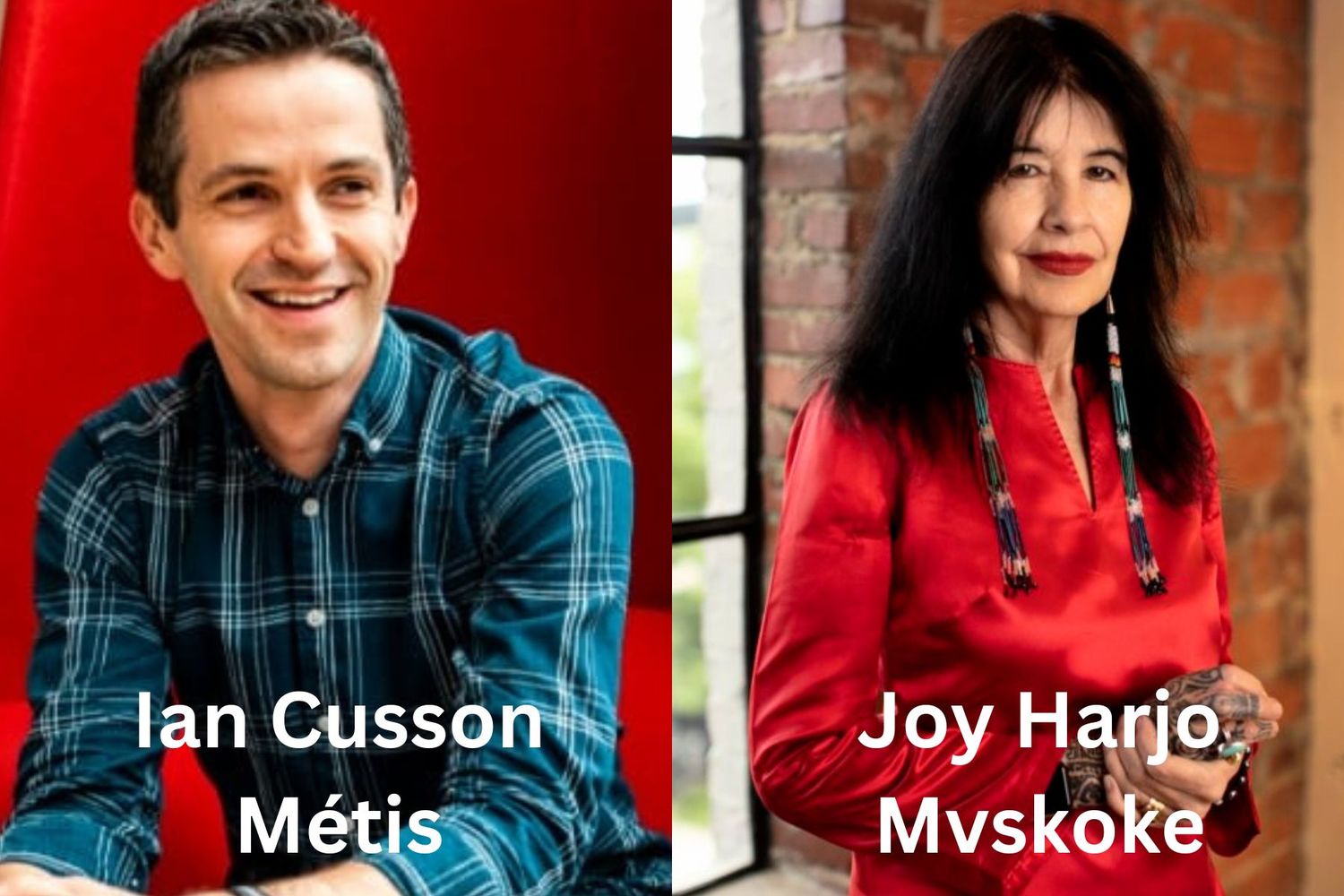
Music by Ian Cusson
Text by Joy Harjo
Commissioned by the Canadian Opera Company for the Free Concert Series in the Richard Bradshaw Amphitheatre.
First performed by Rebecca Cuddy, Marion Newman, and Gordon Gerrard in January, 2020 by digital broadcast from the Four Seasons Centre in Toronto.
Text by Joy Harjo:
A woman, a woman
a woman can’t survive,
a woman, a woman,
a woman can’t survive
by her own breath alone
she must know the voices of mountains
she must recognize the foreverness of blue sky
she must flow with the elusive bodies of night winds
who will take,
who will take her into herself
who will take her into herself
look at me
I am not a sep’rate woman
look at me
I am the continuance of blue sky
I am the continuance of blue sky
I am the throat of the mountains
a night wind who burns
with every breath she takes